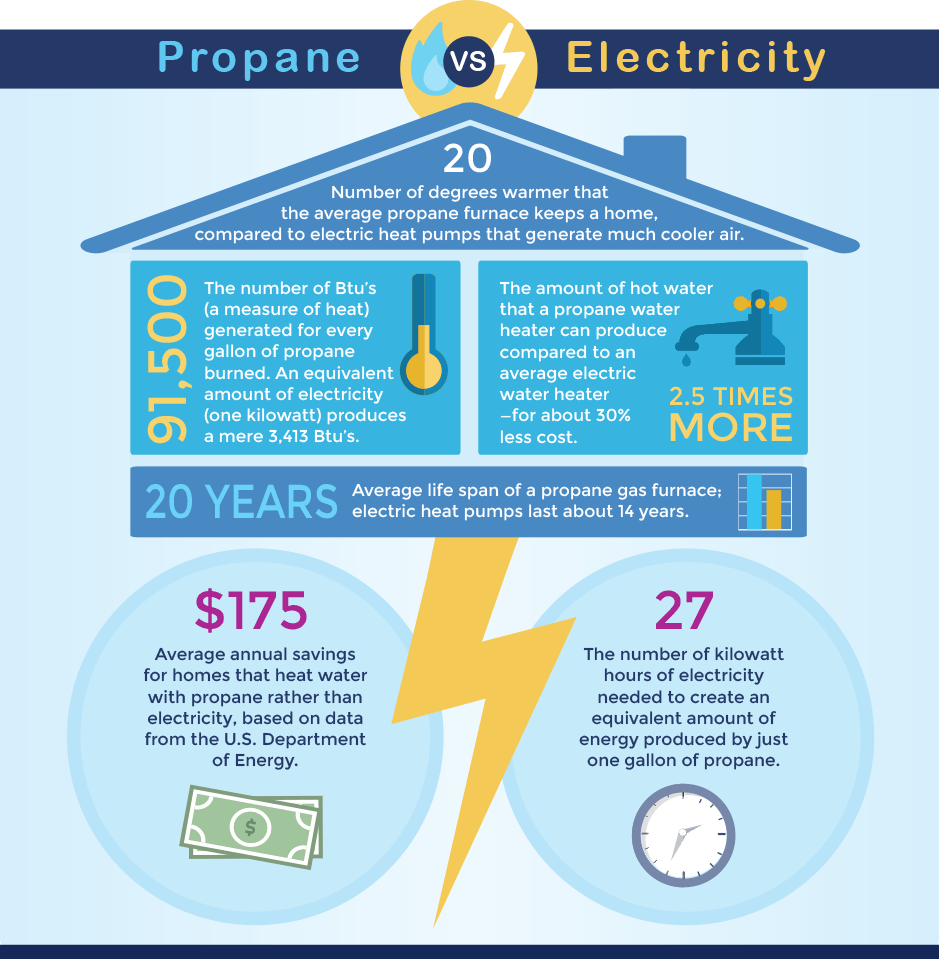
New Yorkers are replacing old electric appliances with modern, energy-efficient propane appliances, and saving money in the process. Propane costs less to operate, performs better, and produces fewer emissions than electricity across nearly every use in the home. Here’s how the two compare.
Where Propane Outperforms Electric
Cost and Performance
Propane appliances consistently cost less to run and perform better than their electric counterparts.
- Water heaters: Propane water heaters cost 30% less to operate than electric ones, or 60% less with a tankless model. They also produce about twice as much hot water in the same amount of time.
- Stoves and cooktops: Propane offers precise temperature control that electric stoves can’t match, and costs less to operate. It also keeps working during a power outage.
- Clothes dryers: Propane dryers dry laundry 25% faster than typical electric models.
- Space heaters: Vented propane space heaters cost significantly less to run than portable electric heaters, and are easy to install, highly efficient, and extremely safe, making them a great option for garages and other cold spaces.
Environmental Impact
Propane is one of the cleanest-burning carbon-based fuels available and produces fewer emissions than electricity across the board.
- Homes powered by propane produce nearly 30% less carbon dioxide than all-electric homes.
- Using propane directly for heating, hot water, cooking, and clothes drying can cut greenhouse gas emissions by up to 50%. Propane clothes dryers alone save over 2,000 pounds of carbon dioxide over their lifespan compared to electric models.
- Propane is nontoxic and won’t contaminate soil or water if it leaks, so it doesn’t carry the same environmental cleanup regulations that other fuels do.
Energy Efficiency
Propane wastes far less energy than electricity, from production to the moment it heats your home.
- When you account for the full energy journey, from extraction to delivery, propane is about 87% efficient, compared to just 32% for electricity.
- A high-efficiency propane furnace wastes less than 10% of its fuel during combustion.
- Electricity, by contrast, loses more than two-thirds of its energy during generation and transmission, before it even reaches your home.
Make the Switch to Propane Today
If you’re ready to lower your energy costs and reduce your environmental footprint, contact your local propane company today to learn how easy it is to convert your electric appliances to propane.
Sources: National Propane Gas Association; Propane Education & Research Council.